Showing posts with label Simple recipes. Show all posts

Friday, July 6, 2018

Niramish Kochur Saag (Mashed taro stems Stir Fry)

'Kochu'(Taro) is a very popular vegetable in Bengal. It is cultivated in those areas where the soil is high in moisture content. Actually, it is one of the few crops which can be grown in flooded areas. In Bengal, it is known as 'Kochu'. The tender shoots (kochur loti), stems (kochur saag) and leaves (kochu para) are also edible. It can be cooked with vegetables, legumes, fish head and prawns. In some parts of Assam and Bangladesh, it is cooked with dried fish. In fact, there is a popular 'Sylheti' recipe known to be cooked with dried fish and taro shoots. Taro is a very versatile vegetable which is highly nutritious. 
Kochur saag is a stir fry of boiled mashed taro stems. This delicacy has always been on the list of my family's favourites since decades. My father in law enjoyed it the most. Some steamed rice and a small bowl of kochur saag and his happiness had no boundaries. He would also suggest us to cook numerous variations of this dish using hilsa fish head or boiled chickpeas. In this recipe, we will be using fried peanuts. So finally, let's get started.


Ingredients:

  • Kochur Saag: 1 kg
  • Water: To boil the kochur saag (if required)
  • Mustard Oil: 100ml
  • Cumin Seeds: 1/2 tbsp
  • Dried Red Chillies
  • Green Chillies
  • Bay leaf
  • Peanuts: 30 grams
  • Tumeric Powder: 1 teaspoon
  • Salt: As per requirement
  • Sugar: As per requirement( I've added 1/2 a tablespoon)
  • Ghee: A tablespoon or more if you likeπŸ˜…πŸ˜…πŸ˜…
Method:

For prepping the saag:
Kochur Saag before peeling

Always check for itchiness while cutting the saag. If it makes your hands itchy, it might itch your throat as well after being cooked. 
  1. Peel and cut the kochur saag as shown in the picture below.
  2. Now boil the kochur saag in a deep bottomed kadhai. Add very little water if required as the saag releases enough and now let it cook till it becomes soft.
  3. Now drain the water and let the saag cool down.
  4. Now squeeze out as much water as possible and keep aside.
If you are adding peanuts then fry some in oil and set aside.


For the stir fry:

  1. Heat some oil in a pan and let it come to the smoking point.
  2. Now add the cumin seeds, dried red chillies and let it splutter.
  3. Add the turmeric powder, salt and sugar.                                                                                      
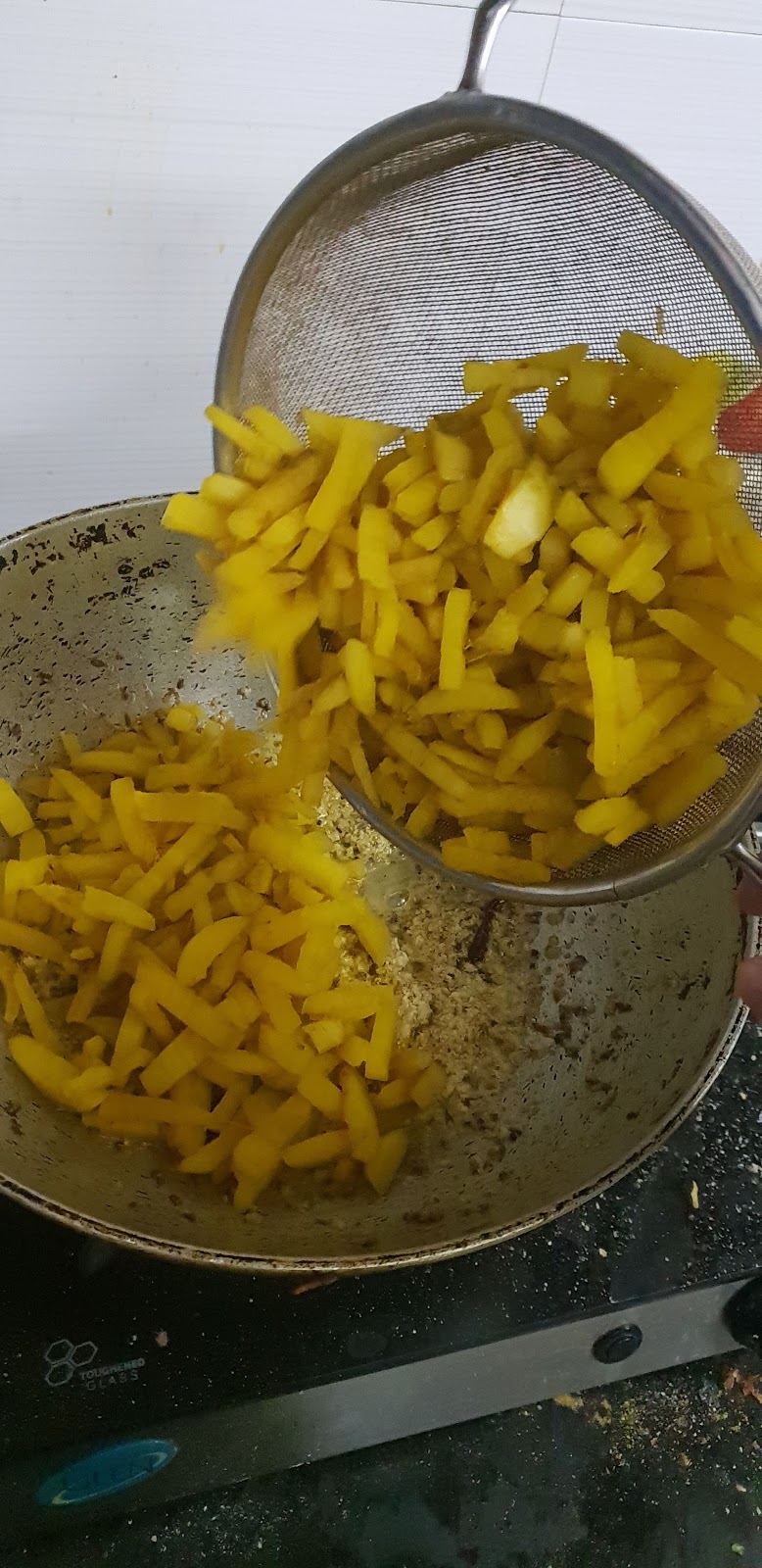
  4. Now add the mashed kochur saag, green chillies, fried peanuts and saute it well

    .
  5. Let it cook till the oil separates and the saag becomes somewhat darker in colour.
  6. Top it up with a tablespoon of ghee and serve it with steamed rice.

Tip: Some people might be allergic to Taro and its other parts. It is best to check for all your allergens before consuming this vegetable

Thursday, July 5, 2018

Thor Bengali Recipe (Banana Stem Stir Fry)

I remember during my childhood days, we had a small banana garden in our backyard. We had a never-ending supply of 'Thor' (banana stems) and 'Mocha' (banana flowers)  throughout the year. My mother used to take care of them like her own child but used to scream and run away as soon as she saw a caterpillar relishing over the leaves or snails attached to the stems! Winters are harsh in my Assam so the plants were unable to bear the cold and die resulting no fruits but flowers. But as the weather changed, they used to grow back on their own without doing any effort. The thor and mocha used to be so organic and fresh and my father and elder sister enjoyed eating it the most. My sister used to call this 'tube light' because it somehow looked like that. I had no interest in eating such gems of our culture. I was happy to have my 'sheddo bhat' with 'dim sheddo' (boiled egg) and butter and refused to eat anything else apart from that. Though sheddo bhat will always remain my all time favourite, now I regret not eating anything of my mother's skills. Therefore, nowadays I try to grab any eatables originated to my culture and make a call to my mother asking her to share her recipe then prepare and if it becomes a success, then write it down on a blog so that my children don't face any difficulties if they try to taste our culture in the future.

Moving on to the banana stems, they are low in calories and highly nutritious. They are said to have many benefits such as the removal of kidney stones, weight loss, managing blood pressure and many more. This is an interesting stir free which tastes great with added health benefits. Try it once and I am sure you'll love it.
Image credit: Anu TChatterjee

Ingredients:

  • Banana stem or Thor: 1 small
  • Water: To boil the thor in a pressure cooker
  • Ripened Jackfruit seeds ( Kathal Bichi): 10 to 12 Boiled and cut diagonally into 4 halves (Optional)
  • Coconut paste or grated coconut of 1/2 a coconut
  • Mustard, poppy seeds and chilli paste: 1 and 1/2 tablespoon
  • Green Chillies: 2 or 3
  • Cumin seeds: 1Tsp
  • Dried Red Chilli: 1
  • Turmeric powder: 1 teaspoon while boiling the thor and 1 teaspoon while stir frying
  • Chilli Powder: 1 teaspoon (Add more or less as per requirement)
  • Salt: As per requirement
  • Sugar: As per requirement
  • Mustard oil: 3 to 4 tablespoon (Add less or more according to your needs)
  • Roasted Panch Phoran Powder: 1 Tablespoon
  • Grated coconut: For garnishing
Method:

Prepping the Thor:
  1. Peel and cut the thor as shown in the pictures below


    Image Credit: Anu TChatterjee
         
    Image Credit: Anu TChatterjee


  2. Then add some salt, turmeric and adequate water to boil the thor for about two whistles and remove the pressure and strain the water.
For the stir fry:

  1. Heat 3 tablespoon mustard oil in a heavy bottomed kadhai.
  2.  Once the oil reaches the smoking point, fry the jackfruit seeds and set aside
  3. In the same oil add the dried red chillies, cumin seeds and allow it to splutter.
  4. Now add the coconut and ginger paste and saute for a minute in medium flame.

  5. Next, add the boiled thor along with the fried jackfruit seeds and saute again.
  6. Add the turmeric powder, chilli powder, salt, sugar, green chillies and saute it.
  7. Now add the mustard and poppy seeds paste and saute it again then cover and cook in low to medium flame for about 5 minutes.
  8. Switch off the flame and add the panch phoran powder and garnish it with grated coconut.

This recipe is better served with rice. If you enjoy this recipe as much as I do, please share and comment below. Take care.

Monday, July 2, 2018

Posto Borar Jhol (Poppy seeds fritters in a light gravy)

In Bengal, white poppy seeds are called as 'posto'. It plays an integral part in Bengali cuisine. Be it vegetables, fish, meat or eggs, every dish has a posto variant. My sister-in-law lovingly calls me Mrs 'posto shorshe bata' (poppy seeds and mustard paste) which is absolutely correct. I love the texture, aroma and the taste which it gives to any food. The camaraderie between these lovely seeds takes the dish to another level.

The recipe which I'm going to share today actually belongs to my inlaws. They used to cook this with some eggplants and potatoes and enjoyed it with some steamed rice and it satisfied their hunger and taste buds altogether. My mother in law was the one who encouraged me to learn this amazing recipe because it is one of her favourites. My co-sister in-law was the one who taught me how to cook this mouth-watering dish. When it comes to food, proper credits must be given. Food solely doesn't satisfy the tongue and stomach. The person who cooks is also satisfied when his or her talent is praised. Their face glows with pride and they are motivated to create more magic in the kitchen.

Enough of narration now let us start this amazing recipe:

Ingredients:

For the fritters or boras:

  • Poppy seeds- 1/2 a cup
  • Green chillies- 2 No.s
  • Kalo Jeere (Kalaunji): 1/4 Tsp
  • Salt: To taste
  • Sugar: A pinch
  • Whole Wheat flour: 2 tbsp
  • Mustard Oil: To shallow fry

For the fried potatoes and eggplants:
  • Potatoes: 2 large (Cut diagonally)
  • Eggplants:2 large (Cut diagonally)
  • Salt: 1/4 Tsp
  • Turmeric powder: 1/2 Tsp 
  • Mustard Oil
For the gravy or jhol:
  • Tomato: 1 small cut into small pieces
  • Panch Phoran(Bengali Five Spices): 1/2 Tsp
  • Bay leaf: 1
  • Dried red chilly: 1 No.s
  • Cumin powder: 1Tbsp
  • Tumeric powder: 1Tsp
  • Chilli powder: 1
  • Salt: To taste
  • Sugar: 1/2 Tsp
  • Mustard Oil: 2 Tbsp
  • Ghee(Clarified butter): 1 Tbsp

Method:

  For the fritters:

  1. Make a thick paste using poppy seeds, green chillies, turmeric powder, chilli powder, salt, sugar and wheat flour.
  2. Mix the kalaunji into the batter and give it a stir.
  3. Heat some mustard oil in a wok kadhai till smoking point.
  4. Put a little drop of the batter into the hot oil and let it shallow fry till golden brown.
  5. Fry all the fritters and set aside.


Next fry the potatoes and eggplants separately till golden brown and set aside. The potatoes should be half done and the eggplants should be fried till it's completely cooked.


For the gravy or jhol


  1.  Heat 2 tbsp mustard in the same kadhai.
  2. Add panch phoran, dried red chilli, bay leaf and allow them to splutter.                                                              
  3. Make a paste using cumin powder, turmeric powder, salt and sugar and pour into the hot oil. 
  4. Add the half done potatoes and the chopped tomato and saute until the oil separates.
  5. Add water up to the desired consistency and let it come to a boil.
  6. Wait till the potatoes are done.
  7. Now switch off the flame and add a teaspoon of ghee to the gravy.
  8. Arrange the fritters and fried eggplants in a bowl and pour the hot gravy over it.

  9. Serve it with some steamed rice.

This is a comfort food. When my soul craves for home cooked Bengali food, I try to make this. Try to keep the gravy thin because it will taste better when eaten with rice.


Monday, June 25, 2018

Chhoto Macher Jhol

Bengalis and their love for fish cannot be expressed in a few sentences. Every Bengali function is incomplete without fish. In fact, many Bengali families start the first meal of the day with fish and rice. There are numerous styles of cooking fish in a Bengali family. Some fishes have a distinct technique of cleaning and cooking. The technique of cooking depends upon the size, fat content and bones. It can be fried, steamed, cooked in simple ginger tomato based gravy or can be cooked in mustard gravy. Some also like to cook this with vegetables or with yoghurt.


My love for fishes didn't start initially. Initially, I found them distasteful, ugly, smelly and disgusting. I developed feelings for them as I mentioned earlier, gradually. Now like many Bengalis I can't imagine a day without fish. The love is pure and completely true. Finally, without wasting any further moment, let's start the procedure.


Ingredients:


  • Small Fishes ( I used Mourola) : 200 grams
  • Potatoes: 2 Medium sized chopped
  • Onions:2 Medium sized chopped
  • Tomatoes:1 Medium sized
  • Mustard Oil: 3 Tbps
  • Nigella Seeds (Kalo Jeere or Kalaunji): 1/2 Tsp
  • Turmeric Powder:1/2 Tsp to fry potatoes and 1/2 Tsp for marination
  • Chilly Powder: 1Tsp (Add less or more depending upon your taste)
  • Green Chillies: Optional
  • Water: 1 cup (Less or more according to the consistency of the gravy)
  • Salt: As per requirement
  • Sugar: A pinch
  • Coriander leaves: To garnish

Method:

  1. Clean and wash the fishes accordingly.
  2. Marinate the fishes with 1 tbsp mustard oil, salt, sugar, tomatoes, turmeric powder, chilly powder, onions and tomatoes for around 10 minutes.
    Marinated with spices
  3. Meanwhile, heat some mustard oil in a kadhai and temper it with some nigella seeds.
  4. Once the oil gets tempered, fry some potatoes with 1/2 tsp turmeric powder and some salt.
    Frying potatoes for the gravy
  5. Once the potatoes are half done, add the marinated fish and water and bring it to boil for around 10 minutes. Be gentle while mixing the gravy or else the fishes might break.
  6. After 10 minutes, when the potatoes are done, switch off the flame.
  7. Garnish the gravy with chopped coriander leaves.
    Mourola Maacher Jhol
  8. Serve with hot steamed rice.

Sunday, June 24, 2018

Easy Sylheti Recipe (Kakrol pur bhaja or stuffed teasel gourd fritters)


There is an undying love for food in our system. Whatever we do, no matter how much tired we are, the thing which refreshes our mind is a good home cooked meal we receive when we return home. The aroma in the kitchen is so inviting that it makes us drop our bags and rush towards the dinner table (only after we finish washing our hands!!!). This faithfulness towards my tastebuds and stomach makes me post another favourite recipe of mine. My mother always used to make this which I initially disliked during my childhood days. But the unavailability of 'Sylheti' cuisine in my hometown makes me crave for such things very badly. 

Sylheti food is mainly originated from the Sylhet district in Bangladesh (Previously India). There are sizeable populations in the Indian states of Assam, Meghalaya, Tripura and Manipur. Their staple diet is fish and rice. Their choice and method of cooking are very distinct from that of non-Sylheti cooking. Their food is tangy, spicy and also sometimes, has a hint of sweetness to it.

So, finally let's get started!!!


 Ingredients:

For the stuffing:
  • Kakrol (Teasel Gourd): 6 pieces (Please make sure the kakrol is large in size. Small ones cannot be filled).
  • Mustard seeds: 3 tablespoon
  • Poppy seeds:    3 tablespoon
  • Whole green chillies: As per taste ( I used 3)
  • Chopped green chillies: As per taste (I used 2)
  • Chopped onion: 1
  • Turmeric Powder: 1/2 teaspoon
  • Chilli Powder: Optional (I used 1/2 teaspoon)
  • Salt: As per taste
  • Sugar: 1/4 teaspoon
  • Mustard oil: 1 tablespoon to add into the paste

For the batter:
  • Rice Flour: 3 tablespoon
  • Wheat Flour: 2 tablespoon
  • Mustard Oil: 1 tablespoon
  • Nigella Seeds (Kalaunji or Kalo Jeere): 1/2 teaspoon
  • Turmeric powder:1/2 teaspoon
  • Chilli Powder:1/2 teaspoon
  • Salt: As per taste
  • Sugar: A pinch
  • Water:1/2 a cup (Add more or less. We want the batter to be neither too thick or thin.)
Mustard Oil: For Deep Frying.


Method:


  1. Wash and remove the ridges of Karol. Cut them into vertical halves and pressure cook using salt and water for 1 whistle and remove the pressure as soon as possible. We will fry them later on. 
  2. Now the toughest job, scrape out the seeds and the flesh of the Kakrol using a spoon after they have cooled down. 
  3. Now discard the hard seeds and mash the flesh using your hands
  4. Make a paste using mustard seeds, poppy seeds and green chillies.
  5. Finely chop the onions and green chillies (I'm not a pro chef, so was unable to chop them that finely!!!).
  6. Now mix the chopped onions, chopped green chillies, mustard and poppy seed paste, turmeric powder, chilli powder, salt, sugar and a tablespoon of mustard oil.
  7. Combine the mustard mix with the kakrol's flesh.
  8. Put the mix into the halved kakrols equally. After stuffing the kakrols, put them into a refrigerator for half an hour.
  9. Now make a batter using the rice flour, wheat flour, turmeric powder, chilli powder, nigella seeds, salt, sugar, mustard oil and water.
  10. Dip the stuffed kakrols into the batter and deep fry them in mustard oil.
  11. Now serve them with hot steaming rice. 
  
Tip: For additional 'Sylheti' zing, fry some dried whole red chillies in the same oil and while eating, mix the rice with a chilli and some oil