Wednesday, July 4, 2018

Tips for bathing a newborn safely

Bathing a baby seems to be unnerving but actually, it isn't. Once you get the hang of it, you will soon be able to do this task very easily. It's better to take assistance from someone who is experienced for a few days before doing this single-handedly. Until the umbilical cord has fallen, it is advisable to keep the cord dry and thus sponge bath becomes an easier option. Handle the umbilical cord according to the paediatrician's advice.

Babies have very gentle skin so it is always advisable to use the toiletries meant for their skin type. To keep his or her supple and soft, use products which are free of parabens and sodium lauryl sulphate. Try to keep the products as natural as possible and also look in for ingredients which have more hydrating properties like Vitamin E and Aloe Vera. Always use a tear-free shampoo and body wash so that you don't hurt their gentle eyes. Also, try to use the products which are less scented because artificial smell might irritate the baby.
Image Credit:http://nailthataccent.com/baby-bath-products-that-i-will-buy-again/


Essential tips for bathing a newborn:
Image credit https://www.mom365.com/baby/baby-care/tips-for-bathing-a-newborn:.


  1. Never leave the baby unattended, not even for a second because they can drown easily in about an inch or less of water. I have earlier mentioned this in my earlier post. Every parent should feed this in their mind. It is better to keep all the essentials (toiletries, towel, clothes, etc.) ready beforehand and give full attention to the baby while he or she is in the bathtub.
  2. Wear something which you don't mind spoiling while bathing the baby. Also, keep your nails short and remove all your accessories such as rings, bangles, etc so that you don't hurt the baby.
  3. Check the water temperature. The water shouldn't be too hot or too cold. The best way to check the water temperature is by placing your wrist or the inside of your elbow. If it feels comfortable then it is appropriate for the baby. Also, never bathe a newborn or toddler under running water. The temperature is sometimes unexpected and might not be favourable to them.
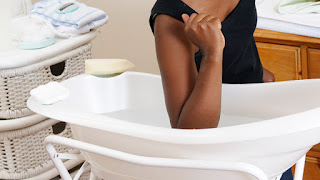
    Image Credit
  4. Always try to use the tubs which are designed for the newborns. Choose the ones which are designed to support the newborns head and neck.  Toddler's bathtubs are deeper and don't have a headrest. If you don't plan to buy a bathtub, use your kitchen sink. But make sure you don't let the baby's head touch the sink's tap. Whether or not you use a bathtub, make sure to support your baby's neck and head because the neck area is weak and newborns cannot support their head on their own.
  5. Avoid bubble bath. This might lead to urinary infections in newborns. Always clean the diaper area and the skinfolds well. Try to stay away from chemicals as much as possible. Use the bath products are meant for their gentle skin. Also, use very soft towels to soak water from your baby's skin. Regular towels can be harsh towards their delicate skin.
  6. Newborns don't require bath that frequently. It is okay to bathe them twice a weak. Over bathing may actually dry out their skin. Babies, when are able to crawl and walk tend to make themselves dirty and thus require bath regularly.
  7. Babies might get irritated initially during their bath times. Therefore, keep the timings short and quick.

I hope you find this article useful. There is no task a parent cannot do. Handling a newborn is difficult but it isn't impossible. Always follow the paediatrician's advice and your instincts and your life will be much easier.

Monday, July 2, 2018

Posto Borar Jhol (Poppy seeds fritters in a light gravy)

In Bengal, white poppy seeds are called as 'posto'. It plays an integral part in Bengali cuisine. Be it vegetables, fish, meat or eggs, every dish has a posto variant. My sister-in-law lovingly calls me Mrs 'posto shorshe bata' (poppy seeds and mustard paste) which is absolutely correct. I love the texture, aroma and the taste which it gives to any food. The camaraderie between these lovely seeds takes the dish to another level.

The recipe which I'm going to share today actually belongs to my inlaws. They used to cook this with some eggplants and potatoes and enjoyed it with some steamed rice and it satisfied their hunger and taste buds altogether. My mother in law was the one who encouraged me to learn this amazing recipe because it is one of her favourites. My co-sister in-law was the one who taught me how to cook this mouth-watering dish. When it comes to food, proper credits must be given. Food solely doesn't satisfy the tongue and stomach. The person who cooks is also satisfied when his or her talent is praised. Their face glows with pride and they are motivated to create more magic in the kitchen.

Enough of narration now let us start this amazing recipe:

Ingredients:

For the fritters or boras:

  • Poppy seeds- 1/2 a cup
  • Green chillies- 2 No.s
  • Kalo Jeere (Kalaunji): 1/4 Tsp
  • Salt: To taste
  • Sugar: A pinch
  • Whole Wheat flour: 2 tbsp
  • Mustard Oil: To shallow fry

For the fried potatoes and eggplants:
  • Potatoes: 2 large (Cut diagonally)
  • Eggplants:2 large (Cut diagonally)
  • Salt: 1/4 Tsp
  • Turmeric powder: 1/2 Tsp 
  • Mustard Oil
For the gravy or jhol:
  • Tomato: 1 small cut into small pieces
  • Panch Phoran(Bengali Five Spices): 1/2 Tsp
  • Bay leaf: 1
  • Dried red chilly: 1 No.s
  • Cumin powder: 1Tbsp
  • Tumeric powder: 1Tsp
  • Chilli powder: 1
  • Salt: To taste
  • Sugar: 1/2 Tsp
  • Mustard Oil: 2 Tbsp
  • Ghee(Clarified butter): 1 Tbsp

Method:

  For the fritters:

  1. Make a thick paste using poppy seeds, green chillies, turmeric powder, chilli powder, salt, sugar and wheat flour.
  2. Mix the kalaunji into the batter and give it a stir.
  3. Heat some mustard oil in a wok kadhai till smoking point.
  4. Put a little drop of the batter into the hot oil and let it shallow fry till golden brown.
  5. Fry all the fritters and set aside.


Next fry the potatoes and eggplants separately till golden brown and set aside. The potatoes should be half done and the eggplants should be fried till it's completely cooked.


For the gravy or jhol


  1.  Heat 2 tbsp mustard in the same kadhai.
  2. Add panch phoran, dried red chilli, bay leaf and allow them to splutter.                                                              
  3. Make a paste using cumin powder, turmeric powder, salt and sugar and pour into the hot oil. 
  4. Add the half done potatoes and the chopped tomato and saute until the oil separates.
  5. Add water up to the desired consistency and let it come to a boil.
  6. Wait till the potatoes are done.
  7. Now switch off the flame and add a teaspoon of ghee to the gravy.
  8. Arrange the fritters and fried eggplants in a bowl and pour the hot gravy over it.

  9. Serve it with some steamed rice.

This is a comfort food. When my soul craves for home cooked Bengali food, I try to make this. Try to keep the gravy thin because it will taste better when eaten with rice.


Friday, June 29, 2018

All you need to know about bottle sterilizers

When you are feeding formula to your baby, it is very important to sterilize the bottles which you are using to prepare the feed as the newborns have an immature immune system. This makes them prone to many waterborne diseases. Although it is somewhat impossible to create a germ-free environment for the baby, sterilizing bottles help kill microorganisms that harm the baby's health. There are many ways to sterilize the baby bottles be it boiling, chemical sterilization or using a bottle sterilizer. Among all, steaming using an electric bottle sterilizer is something I prefer the most. I have been using this bottle sterilizer every day for 2 years and it does its job efficiently. You might use any sterilizer you wish to. All of them provide an equal amount of sterilization because they create steam through a heating coil. An adequate amount of water is poured into the heating coil and when the power is switched on, the water creates high-temperature steam which sterilizes the bottle efficiently. Make sure you place the opening of the bottles facing downwards.


Here I present you the benefits of using an electric bottle sterilizer:

  1. Effective Sterilization: Steaming the bottles causes sterilization rather than boiling which leads to disinfection only. Sterilizing kills many bacterial spores which are even resistant to boiling. Bottle sterilizers can clean 99.9% of the bacteria which boiling might not be able to do so. Simply plug in your sterilizer and return back after the bottles have been sterilized. You can get clean bottles in a matter of a few minutes.
  2. Convenient: Bottle sterilizers are very convenient to use. There is no water mess all around and it is a hassle-free process. It also requires less time as compared to boiling. One can get a hang of it pretty easily.
  3. Less space consuming: No need of buying a large pot and no need to find a good space to keep it. Bottle sterilizers require very less space. Any table top might be sufficient. 
  4. Safe to use: There is no fear of accidental spillage of hot water and as I mentioned earlier, there will be no water mess. Also, the bottles cool down faster as compared to boiling which might be easier for the parent to take out the bottles and prepare the formula. 

Water poured over the heating coil

Many parents have the tendency of not washing and sterilizing new baby bottles which is an incorrect practice. Bottles may look squeaky clean at first sight but consider the number of bacterias and pathogens which might affect the sanitization property of the bottles. It is always advisable to clean and sterilize all baby bottles or any other utensils before use.


Cleaning the electric steam sterilizer:

Although electric steam sterilizers are very convenient to use, there is only one issue. The heating coil which is placed in the sterilizer might accumulate limescale which eventually damages the metal surface. It is advisable to clean the sterilizer after every two weeks depending upon the scales accumulated. Cleaning a bottle sterilizer isn't a big task. This remedy is almost advisable for all bottle sterilizers but make sure you read the instruction manual which comes with your bottle sterilizer before following these steps.

Pour 100ml white vinegar into the heating coil of the sterilizer and let it stand for 30 minutes to an hour depending upon the amount of limescale accumulated. Then rinse it off using a sponge and a mild liquid soap under your wash basin. Make sure you wash it a bit carefully by avoiding any contact between the wire and water. Also, clean the other pieces of equipment using a wet sponge. Your machine shall be sparkly clean without any deposits.


Bottle sterilizers are actually a boon to motherhood. Depending upon your model,  bottles can remain sterile up to 24 hours with the lid closed. I would recommend every parent to invest in one and see how easy the bottle sterilizing task will become.

Tip: I put RO water in the heating coil while sterilizing the bottles. RO water is less hard than tap water which makes the accumulation of limescale very less.

Wednesday, June 27, 2018

Tips for new mothers

Being a mother is the most tiring and the most satisfying job ever. The Moment the baby arrives, our 24*7 duty starts. Whatever activity we do depends upon the schedules set by the baby. Also, there a group of people giving advice which is sometimes irrelevant. It becomes quite difficult for the mommies to invite this sudden change to their lives. There is no such thing called 'perfect parent'. Nobody's perfect. Everyone learns from the mistakes committed. Comparisons in between parenting techniques of different people aren't correct. One should follow one's instinct and take decisions accordingly. Here are a few tips for the first time mommies.

  1. Sleep Deprivation: I became a mother at the age of 22 and had no idea about this. My baby slept throughout the day and remained awake the entire night! It was a big shock for me. I and my husband spent numerous sleepless nights. It made us frustrated and out of frustration I used to cry and finally found out a solution to sleep when the baby sleeps no matter how many works are pending.
  2. Bathing a baby:  Some people like to bathe their babies daily, but bathing a newborn every day isn't necessary. Its okay to bathe your newborn two to three times a week. It's better to give a sponge bath to babies whose umbilical stump hasn't dried or fallen. After the umbilical cord dries up, tub bath can be given. Use a small tub instead of a standard bathing tub and never leave the baby in the tub unsupervised even for a second.
  3. Feeding a Baby: If you are a new mother, please ask the hospital nurse to teach you the proper latching techniques. Babies, if not properly latched to your breast can make the feedings painful. Find the position which suits you the most and feed accordingly. It's very important to check that the baby passes urine for at least 6 times a day and also keep a track of his weight gain. Please check out this for more breastfeeding related facts. If you are formula feeding your baby, sterilize the utensils required make the formula according to the directions given by your paediatrician.
  4. Shopping for the Baby: Buy only the basic necessities. Babies grow rapidly. Clothing might not fit a baby after a week you have purchased. Instead, invest in gadgets like an electric kettle, a good breast pump, a bottle steriliser and so on. I had shopped for many clothes when my baby was born and I was surprised to see that they didn't fit after a week or 10 days. The result, many of the clothes lie untouched and unused resulting in a waste of money.
  5. Maintain Hygiene: This was told by my gynaecologist right after my baby was born. Babies are vulnerable. Their immune system is weak as compared to the adults it's very important for the members of the family to ensure that the environment in which the baby is living is healthy. It's good to hold or touch the baby with clean hands. Also, wash or sanitize your hands while preparing the formula milk. Also laundering the baby's bedding often is a good practice and always make sure to wash your newborn's new clothes before you make them wear.
  6. Don't Compare: Like I said, comparisons shouldn't be made between the parental techniques, it should also be avoided in case of the growth and progress of the baby. Just because your neighbour's baby was able to turn around at 3 months doesn't mean that your child will also do the same in the exact time. Each baby is different and develops differently.
  7. Capture Moments: Do this regularly. They last forever. Maintain a baby log book and note down everything you wish is worth capturing. I clicked many photos and videos when my baby was young but now I feel I haven't clicked enough. Time travels fast and these captures will always make you feel elated.
  8. Feel Good: Finally, feel good. if you feel good, you will make your baby feel the same. Its ok to frustrate, ok to forget something, ok to make mistakes. At the end of the day, you are the only one who knows your baby more than anyone else does. Always follow your instincts and do what the paediatrician says.

Parents are as wonderful as their baby is. You might make mistakes in parenthood and rectify them for sure. Babies outgrow their parent's lap but never outgrow their heart. Love your baby and always be confident because it ensures success.

Monday, June 25, 2018

Chhoto Macher Jhol

Bengalis and their love for fish cannot be expressed in a few sentences. Every Bengali function is incomplete without fish. In fact, many Bengali families start the first meal of the day with fish and rice. There are numerous styles of cooking fish in a Bengali family. Some fishes have a distinct technique of cleaning and cooking. The technique of cooking depends upon the size, fat content and bones. It can be fried, steamed, cooked in simple ginger tomato based gravy or can be cooked in mustard gravy. Some also like to cook this with vegetables or with yoghurt.


My love for fishes didn't start initially. Initially, I found them distasteful, ugly, smelly and disgusting. I developed feelings for them as I mentioned earlier, gradually. Now like many Bengalis I can't imagine a day without fish. The love is pure and completely true. Finally, without wasting any further moment, let's start the procedure.


Ingredients:


  • Small Fishes ( I used Mourola) : 200 grams
  • Potatoes: 2 Medium sized chopped
  • Onions:2 Medium sized chopped
  • Tomatoes:1 Medium sized
  • Mustard Oil: 3 Tbps
  • Nigella Seeds (Kalo Jeere or Kalaunji): 1/2 Tsp
  • Turmeric Powder:1/2 Tsp to fry potatoes and 1/2 Tsp for marination
  • Chilly Powder: 1Tsp (Add less or more depending upon your taste)
  • Green Chillies: Optional
  • Water: 1 cup (Less or more according to the consistency of the gravy)
  • Salt: As per requirement
  • Sugar: A pinch
  • Coriander leaves: To garnish

Method:

  1. Clean and wash the fishes accordingly.
  2. Marinate the fishes with 1 tbsp mustard oil, salt, sugar, tomatoes, turmeric powder, chilly powder, onions and tomatoes for around 10 minutes.
    Marinated with spices
  3. Meanwhile, heat some mustard oil in a kadhai and temper it with some nigella seeds.
  4. Once the oil gets tempered, fry some potatoes with 1/2 tsp turmeric powder and some salt.
    Frying potatoes for the gravy
  5. Once the potatoes are half done, add the marinated fish and water and bring it to boil for around 10 minutes. Be gentle while mixing the gravy or else the fishes might break.
  6. After 10 minutes, when the potatoes are done, switch off the flame.
  7. Garnish the gravy with chopped coriander leaves.
    Mourola Maacher Jhol
  8. Serve with hot steamed rice.